
Research · Circular Chemistry
Solar reforming
Why make oxygen from water if you could mitigate waste and make useful chemicals instead?
Waste upcycling
Solar fuels
tandem catalysis
Our approach
From waste to value
Solar fuel synthesis is a sustainable and potentially economical technology for producing energy carriers such as “green” H2 fuel through water splitting or liquid fuels from CO2 reduction. Such classical solar fuel reactions are usually limited by the water oxidation half-reaction, which is kinetically and energetically demanding, requires often expensive catalysts and produces solely O2.
Our research aims to overcome these challenges by using alternative oxidation half-reactions to drive the breakdown of waste polymers or chemicals into valuable organic products, thus mitigating waste, generating products of high value and reducing the thermodynamic and kinetic constraints of the oxidative half-reaction. We utilise a variety of novel photocatalysts, including quantum dots and carbon-based light absorbers, as well as photoelectrochemical platforms to convert plastic- or biomass-derived waste into organics and fuel using our solar reforming technology. The oxidative upcycling of biomass and plastic waste can thereby by coupled to the reductive production of H2 or fuels from CO2 reduction.
Our aim is to enhance the sustainability and economic value of solar fuel production by developing processes that simultaneously produce fuels and drive value-added organic transformations while mitigating waste.
Selected work
Recent publications
A selection of recent studies spanning waste photoreforming, scalable solar technologies and circular chemical production.
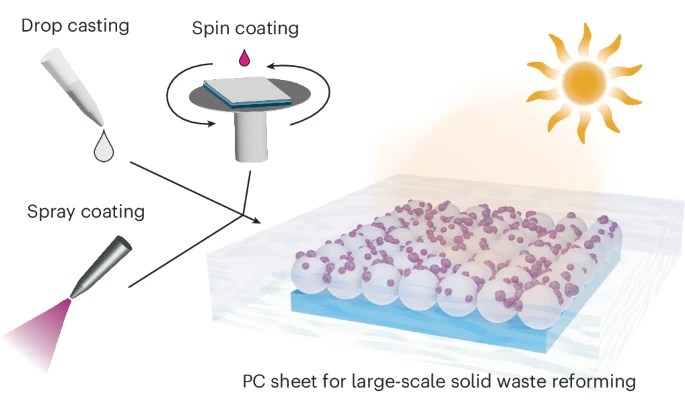
Photoreforming of solid waste on 1 m2 scale using single-source precursor-derived co-catalyst films
Mohamad Annuar, A. B.; Liu, Y.; Bhattacharjee, S.; Slaughter, J.; Mikulska, I.; Sayed, F. N.; Grey, C. P.; Wright, D. S.; Reisner, E. Nat. Chem. Eng., 2026.

Solar reforming of plastics using acid-catalyzed depolymerization
Kwarteng, P. K.; Liu, Y.; Han, C.; Bonke, S. A.; Vahey, D. M.; Pulignani, C.; Reisner, E. Joule, 2026, 102347.

Floatable carbon nitride-plastic composite for paired photocatalysis at the liquid-liquid interface
Rogolino, A.; Linley, S.; Kwarteng, P. K.; Bonke, S. A.; Pulignani, C.; Reisner, E. Chem, 2026, 12, 102827.

Floating solar technologies for sustainable chemical synthesis on open water
Linley, S.; Pornrungroj, C.; Reisner, E. Nat. Chem. Eng., 2026, 3, 34–46.

Solar reforming as an emerging technology for circular chemical industries
Bhattacharjee, S.; Linley, S.; Reisner, E. Nat. Rev. Chem., 2024, 8, 87–105.

Chemoenzymatic Photoreforming: A Sustainable Approach for Solar Fuel Generation from Plastic Feedstocks
Bhattacharjee, S.; Guo, C.; Lam, E.; Holstein, J. M.; Pereira, M. R.; Pichler, C. M.; Pornrungroj, C.; Rahaman, M.; Uekert, T.; Hollfelder, F.; Reisner, E. J. Am. Chem. Soc., 2023, 145, 20355–20364.